Table of Contents
The label Read 100% Leather appears comforting when it comes to purchasing a new wallet, bag or even a pair of boots. However, the term hinges on the modern market, which is currently being characterized as either the heirloom quality item that is going to last for decades or a low end item that is going to peel off in six months.
The leather business is full of misleading marketing jargons meant to pass poor quality products as quality. The greatest offender is the stamp which boasts of Real Leather.
At WeCraft, we believe an informed customer is our best customer. You should know why we only work with high-quality materials, and that is where you need to know about the hierarchy of leather. This is the ultimate reference to what you are really purchasing.
The Anatomy of a Hide
In order to know leather grades you need to know the source: animal hide. A hide is thick though not even.
Imagine that it is tree bark or human skin. The outer layer is the one in contact with the elements; the most protective fiber structure is created in this layer. The deeper you go into the hide the looser and weaker the fibers are.
The primary distinction between grades of leather is merely what part of the hide is utilized and to what extent it has been processed.
The Leather Hierarchy: From Best to Worst
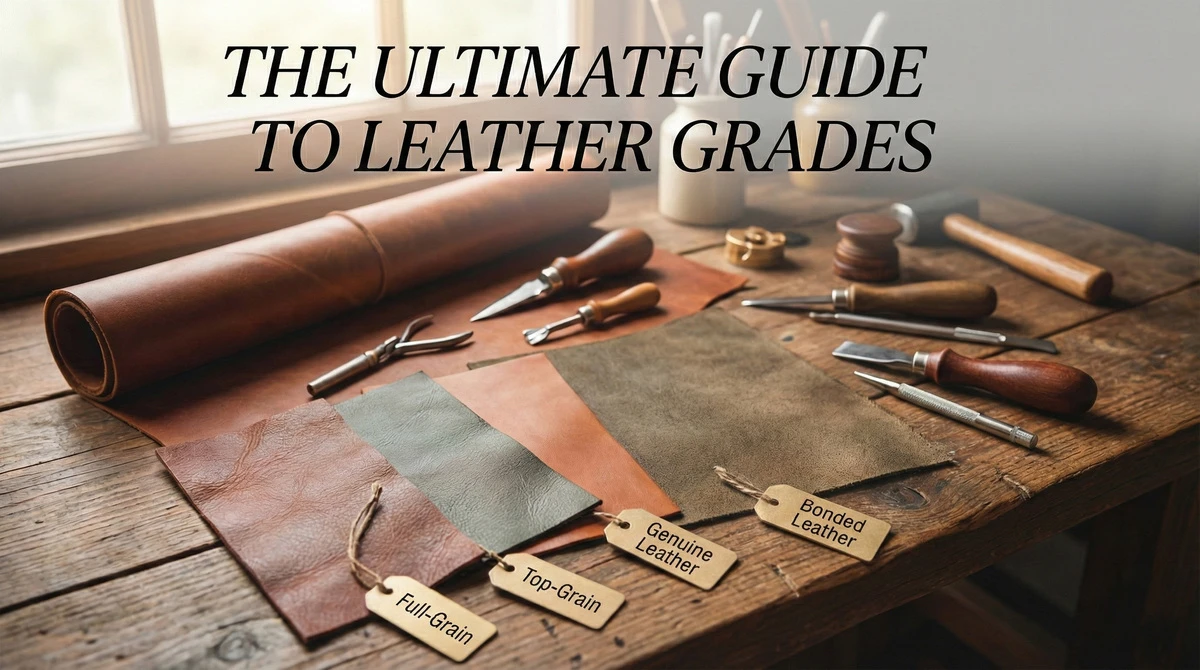
Our leather is graded according to the durability, appearance, the feel and wear.
1. Full-Grain Leather (The Gold Standard)
This is the real deal. Full-grain leather is a product of the highest part of the hide which incorporates all the natural grain.
More importantly, the surface has not been smoothed, rubbed down, or snuffed to eliminate any kind of imperfections. Due to the fact that it is undisturbed, you may encounter natural defects such as healed scars, bug bites, or wrinkles of fat. These are not flaws, they are evidence of genuineness.
- Durability: Unmatched. It is very resistant to tearing as the dense top fibers remain intact making it very strong.
- Appearance: Natural and rough.
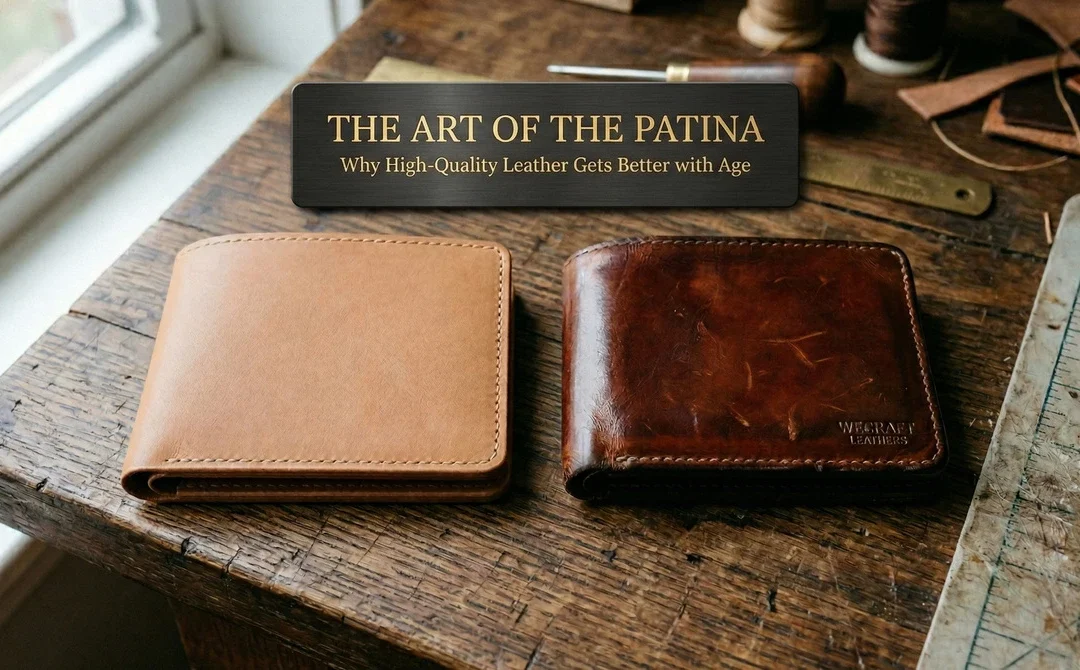
- Aging: This is where full-grain shines. It does not wear away but acquires a sort of patina, a rich, soft luster, which is the result of receiving the natural oils, sunlight and wear. A full-grain wallet of ten years old is better looking than a new one.
- Conclusion: The most appropriate option to a product that has to last a lifetime during everyday wear.
2. Top-Grain Leather (The Compromise)
The second-best quality is top-grain. It is manufactured on the uppermost part of the hide, but the most external part has been chipped away.
Why sand it? To eliminate the above mentioned natural imperfections. After sanding, the surface is then finished with a coating over it to make it appear even and smooth on the surface. The finish also gives it resistance to stains as compared to full-grain.
- Durability: Good, but less durable than full-grain because the strongest fibers have been sanded off.
- Appearance: Very uniform, smooth, and “perfect.” The heavy finishing coat tends to make it look slightly plastic.
- Aging: Since the protective coating is used, top-grain is not breathable and will not form any significant patina. After many years of use, it will then crack.
- Conclusion: A good option when seeking high-end fashion handbags in which a perfect appearance is more important than a durable rugged one, yet the handbag lacks the personality of full-grain.
3. “Genuine Leather” (The Marketing Trick)
This term is the most misleading in the industry. It is technically real leather. However, qualitywise it is a far third.
After the upper grain has been scalped off a hide, the rest of the layers are peeled. These lower layers are loose with fiber structure and are structurally weak. The surface is greatly covered with synthetic fillers to make the surface usable and painted with a man-made grain to seem like top-grain leather.
- Durability: Poor. It also tears easily and it punctures.
- Appearance: Artificial. It appears to be flat and homogenous as the surface is literally painted.
- Aging: It ages poorly. The painting will ultimately peel and crack off the weak fibers of leather beneath.
- Conclusion: Do not use this on things that face friction on a daily basis such as wallets or belts. It is made to appear attractive on the shelf and break down soon after they are bought.
4. Bonded Leather (The Bottom Barrel)
Bonded leather can hardly be called leather. It is the leather world particleboard.
Manufacturers collect scrap, dust and shavings of leather tanneries, grind them into a pulp and then glued them with polyurethane or latex. It is then sprayed in order to resemble leather. It has probably 10-20% genuine leather fabric.
- Durability: Extremely poor. It will peel apart rapidly.
- Appearance: one hundred percent artificial.
- Conclusion: Do not purchase it in case you need to have something lasting longer than a couple of months.
Why We Choose Full-Grain
In a fast-fashion world focused on cheap replacements, choosing full-grain leather is a commitment to quality.
A wallet with a label of a Genuine Leather could be cheaper nowadays but you are more likely to change it three or four times within the following decade. A properly made full-grain wallet, though, is an ally that you will keep all your life, which narrates your history in its changing patina.
Choose wisely. Buy less, but buy better.